

PILE 05: CYCLES
Grief and the ocean, revisited

Friends, strangers, subscribers: the spring swept me up in its cycle! Summer is basically here and I’m still catching up from the springtime.
I think spring is the most fierce season—tougher than the bitter winter, rougher in some ways than the smoke-choked California fall. Spring, a cyclone.
This April came in hot with a 3am ambulance ride to the ER (scariest moment of my life), followed by a month of lingering illness, heartbreak, and much-needed rest. Poppies aflame. It went out with a bang, a sharp left turn, and a big fat stupid sad loss. We are ok and we will be ok. We are alive, which is what matters. I am still feeling the social fallout from a self-centered month, friendships strained and less room for attention and consideration outward as I tended to my self, my kiddo, and my family.
In between the wheezing and sleepless fever nights—counting breaths—and follow-up visits and tears and sad texts there were sweet moments of friendship, neighbors, sunshine, babies, giggles, etc. Thank you, neighbors and babies. There was just no time for newsletters in the last two months. Toddlers bring the intensity on every level: they’re the cutest, the sweetest, the worst, the best, and the most tender. They inspire the most panic and the most love. We are ok! We will be ok!
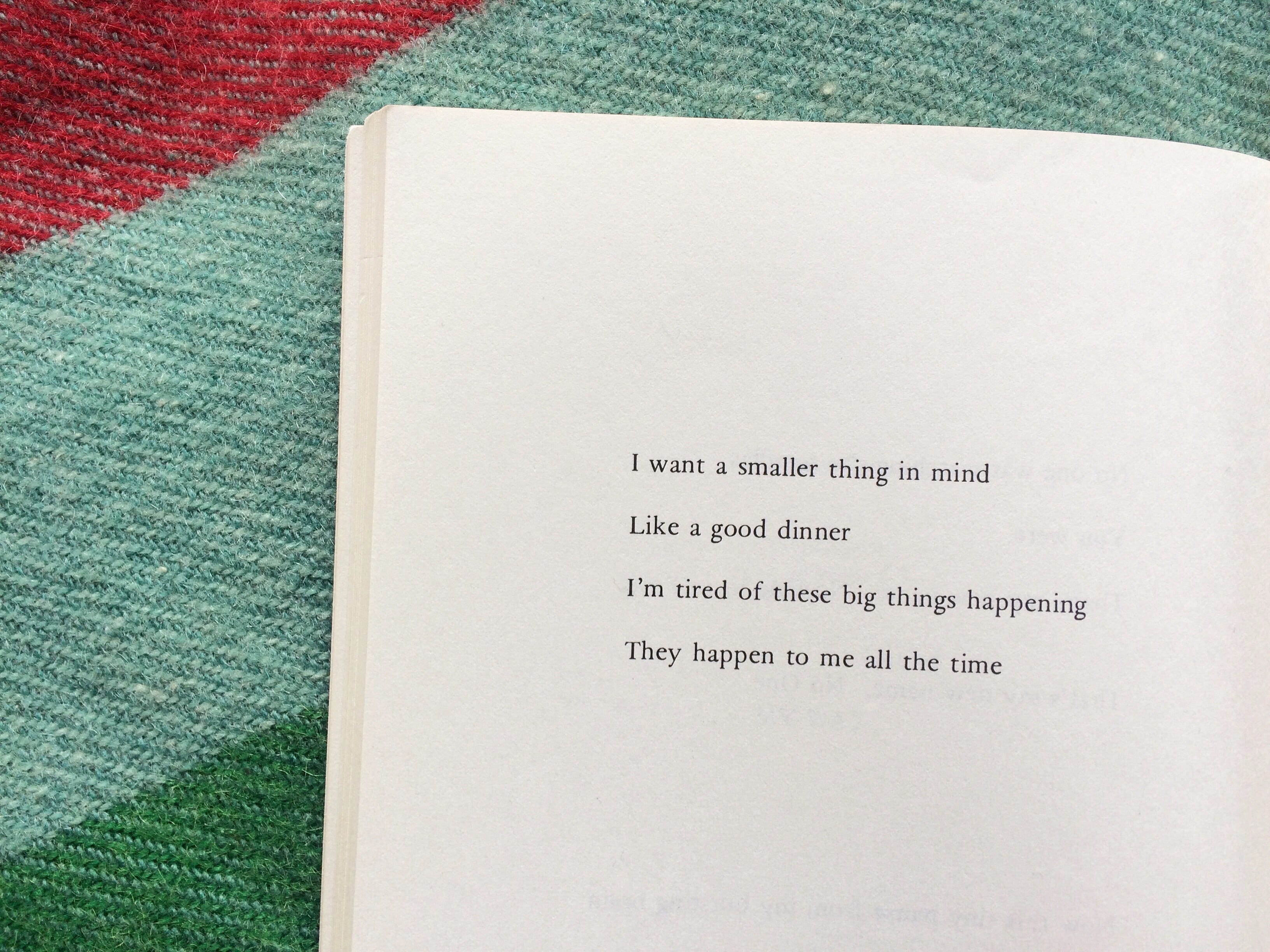
We’re still bearing witness to a genocide and it is infuriating, heartbreaking, so fucking fucked up that it is still happening. Words don’t work. Today I registered to vote as a member of the Peace and Freedom Party, which I guess is kind of a symbolic gesture in California. I feel impotent as a voter in this moment, my options being: senile evil, clown evil, or rotten worm brain. All different shades of backing an apartheid state and a genocide: red, blue, purple. Voting sucks! I’ll still do it, I just think I’ll vote for a radical, feminist, socialist scholar. If my vote is not a reflection of my values, what good is it?1
All of this is to say: I admire all of you weekly newsletter writers. I am slooooooow on the promise of “monthly” and thus I regard your consistency with deep reverence and appreciation. Life is wild and I really cherish the every-Monday-ness of your letters, especially knowing how hard it can be to muster the missive when you don’t feel like saying anything at all. Often, I feel like saying nothing at all. But ok. Enough meta-speak. This is not a newsletter about newsletters.
Today I’m sharing a piece of writing I made in 2018, approximately one hundred years ago. I meant to send this last month, because it is about the wet-spring time, the part of spring that is also winter. Then I meant to share it two weeks ago, because it is about mothers, and Mother’s Day, which is complicated and heavy for many of us. However, I was too mired in the grief to be reflective about the grief, ya know? You’ll have to use your imagination, since we’re now in the hot part of spring that is also kinda summer, at least here in the Bay Area. It’s ok, grief is timeless.
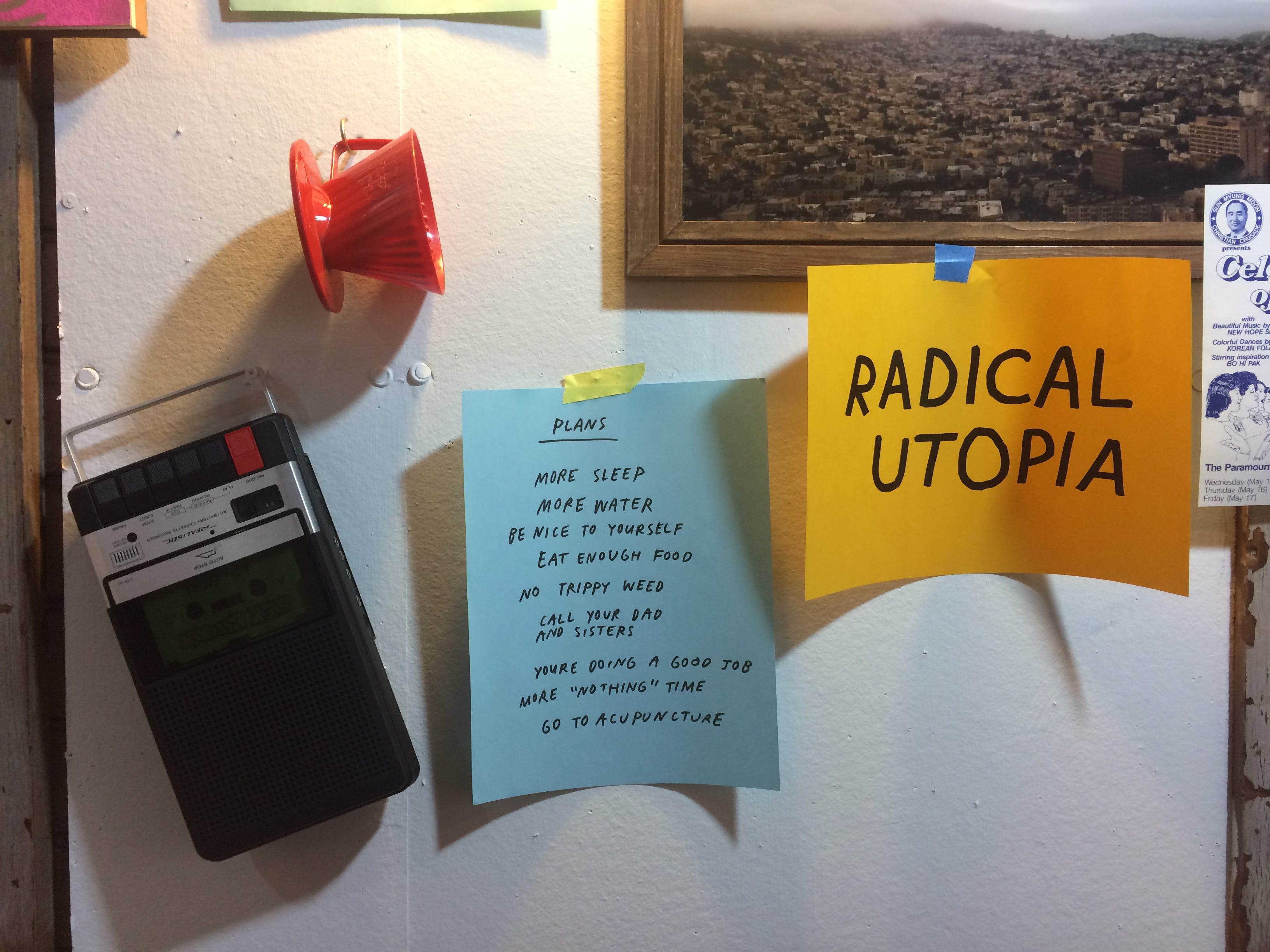
Here is the story of this piece of writing. Back in 2018 I published my writing all by myself, on pastel-colored pieces of paper, folded into a reasonable size, and offered for free to anyone I met. I miss those times. The Headlands times, the times when I saw the ocean every day: ripping, roaring, raging. For two years I had an art studio at the edge of the earth, in a repurposed ammunitions warehouse overlooking a missile site, and beyond, the glittering sea. I was very lucky. Down the hallway, upstairs under the redwood eaves, and downstairs in the dim basement were other artists and poets working furtively in their own little cages.
I say cages because our walls were made of latticed metalwork, installed as temporary infrastructure within an historic building, easy to remove at a future date when the landlord—the National Park Service—might want their space back someday. The cagey walls were accompanied by a welded metal staircase etched with hexagrams from the I-ching and installed in 1999 by sculptor Leonard Hunter. This building was redone in the spirit of the artist-as-renovator legacy of the core Headlands Buildings, which were rehabbed by the artist David Ireland and his crew of friends beginning in 1988. (Look it up! It’s inspiring!)
I remember thinking, “Why on earth would they make this all temporary?” To me, there was no higher use of a former military ammunition warehouse than ARTIST STUDIOS. What better use of a space created for violence and imperialism than ART? It felt like the highest form of remediation. Reuse as renewal, a therapy for the architecture—after years of bitter metal hardness, the taste in your mouth like pennies, finally, a bunch of artists and poets, tucked into their uninsulated wooden corners, a quilt on the lap in the evenings, warm lighting, tinny music playing from a tape deck. A balm for the space, a balm for the landscape. Across the street, musicians in the other repurposed warehouse, and when the windows were open—or not, being single-paned—the sound of a harp, or a synthesizer, or a vocal exercise would waft across the road and into the place where the artists and the poets worked.
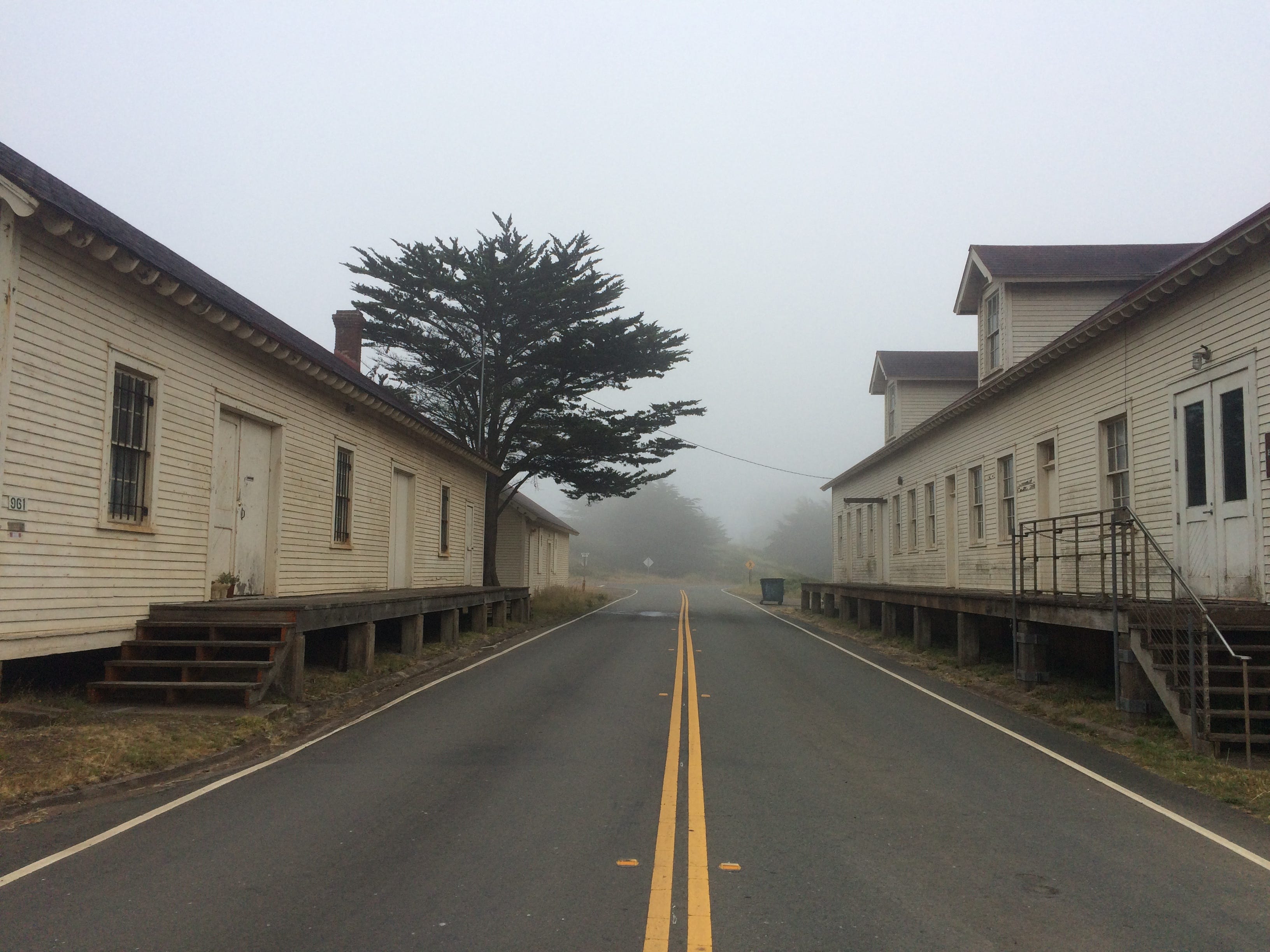
In a series of events that I don’t understand, the Headlands ended the Affiliate Artist program and returned the building to the National Park Service in 2020. “It’s heartbreaking.” It was a great loss for the Bay Area art community, and a signal by the institution that local, emerging artists don’t matter as much as internationally regarded artists with lengthy CVs. As they “narrow[ed] their focus,” they left a lot of people behind.
I’ll always root for local, emerging artists. I’ll always root for space for artists engaged in community, place, and experimentation. I’ll always scoff at monied institutions turning away from locality and towards a highfalutin version of art practice rooted in professionalization and prestige. Biennale-core.
I digress.
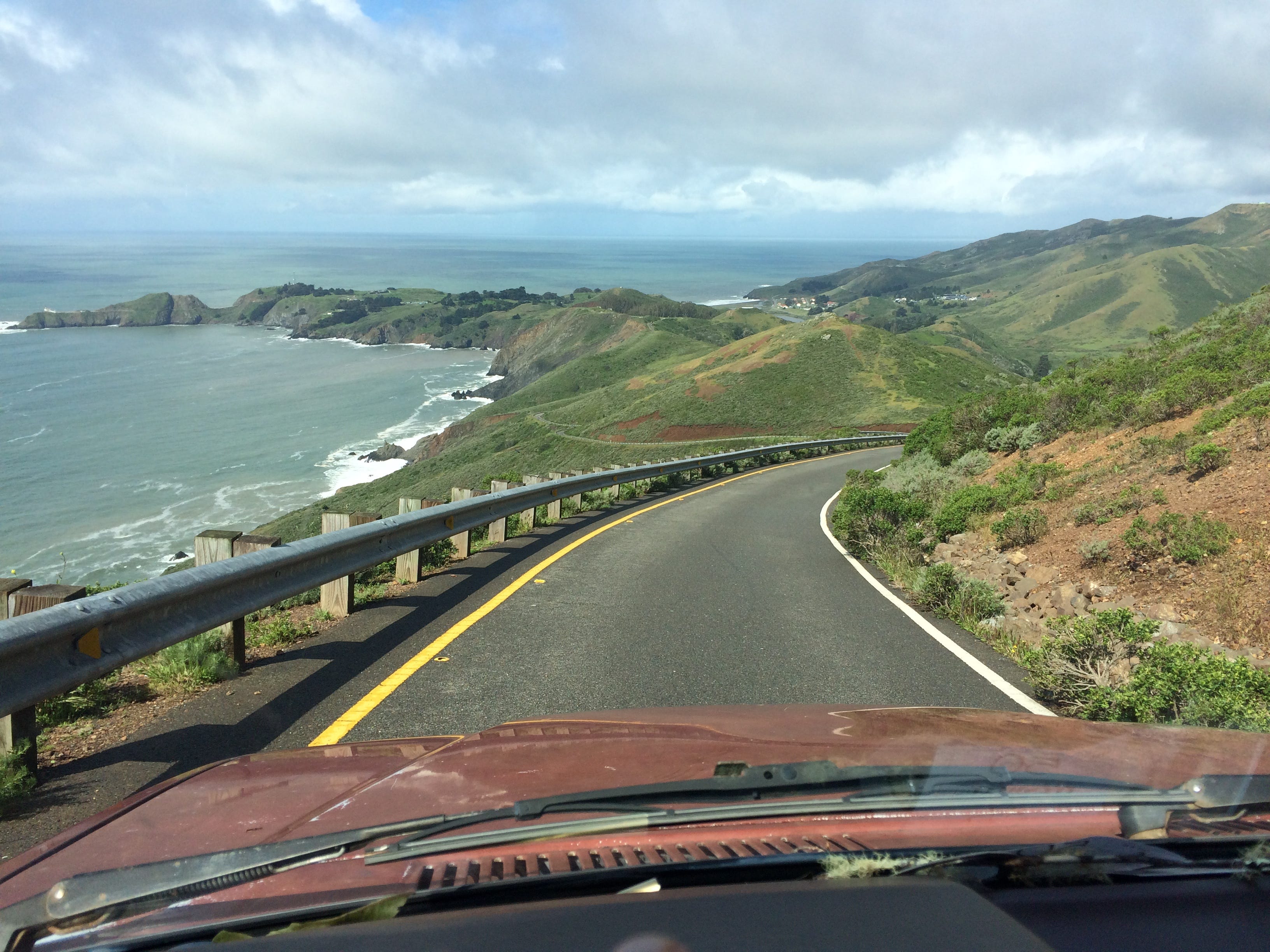
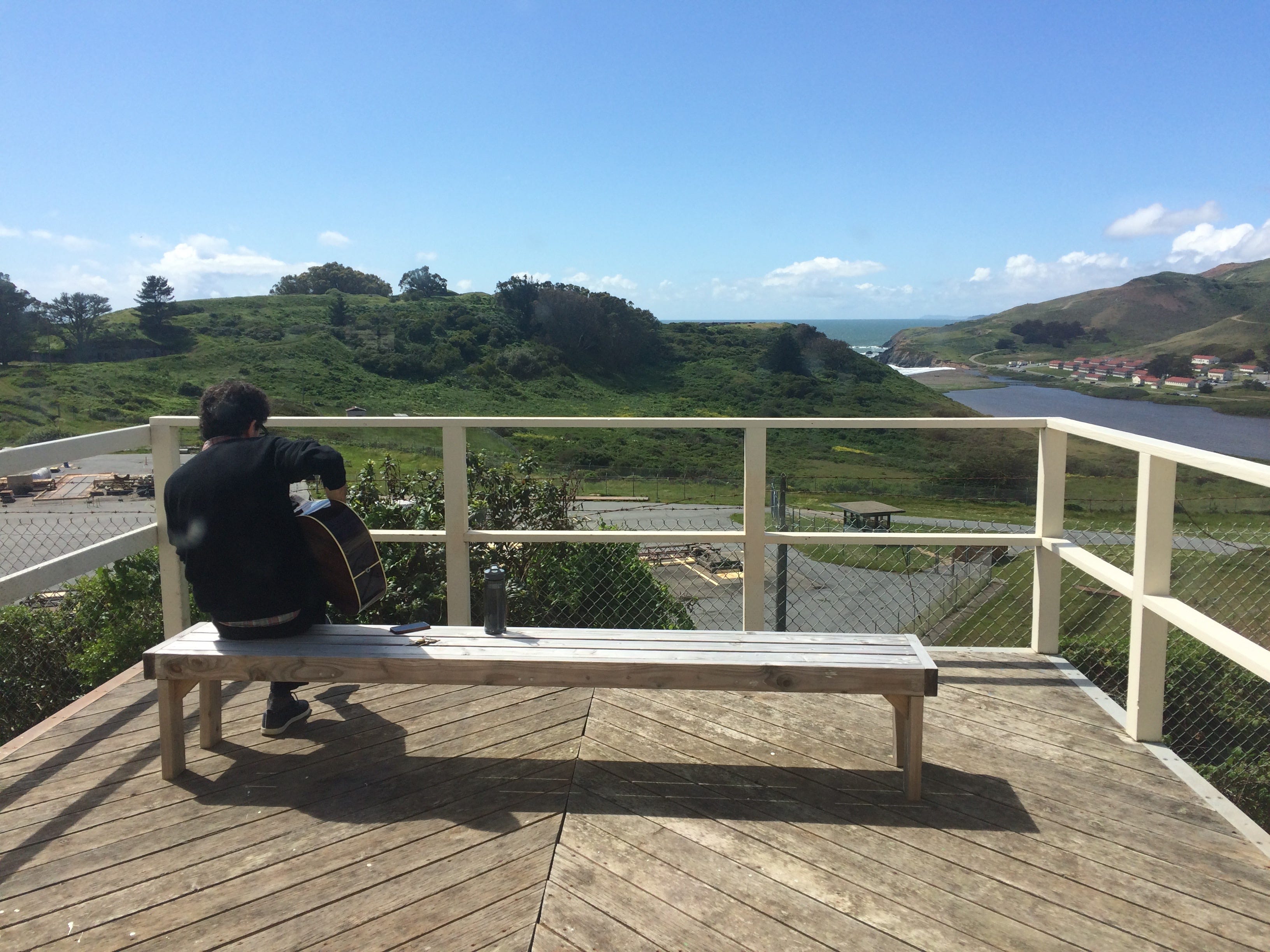
The evenings brought fog, and wind, and my gauzy studio curtains blew around in the draftiness that snuck in through the cracks. Off the west side of the building was a deck with a view to the west, a Nike missile installation below and the sea beyond. It was a blistering place to eat your lunch and maybe encounter another artist, sitting outside with a guitar or notebook or nothing at all but a sweater against the wind. This is what happened to me.
I went out to eat a snack or smoke a spliff or breathe in some salt air and I found Daniel Melo Morales, one of the attic artists with a slanted ceiling studio, quietly, carefully, pulling the strings of his guitar, eyes shut against the blinding sun and glare of the ocean. I sat, we talked about what we were working on, and we decided to collaborate. He had many poignant things to say about my thoughts on grief, some of which made it into this piece of writing I’m sharing today. We performed this piece twice, me reading, with Daniel on looping, looping, looping guitar and a slideshow of the ocean: once at the Headlands in a room that had previously housed three-tiered bunkbeds of young recruits, and once at a little art space behind the post office in Inverness, California, another edge of the world. Both times we made everyone cry.
Now, I offer this writing to you.
I am clearly quite nostalgic about that time in my life: long, lazy, expansive days at the studio, the romantic electricity of new friendships, the magic of the sea gusting through everything. No child, barely a job, cheap rent, a weed habit that gave everything a sweet haze. And yet somehow this piece of writing from that time feels like forever to me. Grief is universal, without a timeline. IMO grief is NOT a cycle, as they say, it’s more like a scribble, pen pressing so hard into the paper that it rips. Grief is a little hole that is always there, changing shape without warning.
As we are struck more and more these days by waves of rage, sadness, numbness, over and over, unspeakable and unfathomable—death tolls climbing, heartless people in power falling further and further out of touch, temperatures rising, the sea sloshing at our doorsteps—it’s helpful to give it a name. It’s grief. It’s loss, and the constant mourning of that loss while we push on, regardless.
In 2018, the veil was very thin for me. I had lost my mother three years prior. A year before, a beloved aunt. The violent, electric spring was here, with its promises and scorching brightness. This was a moment when my grief was crystal clear, ever-present, and seeped into my days. Kind of like now.
So…. we’re nearing the end of my big-ass preamble. Maybe you want to read the attached grief-writing now, or maybe you want to save it for a time when you feel ready for it. Sometimes it’s not the right time to read about grief! This piece is about the loss of my mother, but I think it can also be relevant to someone experiencing other kinds of grief—tangles of feelings, always there, rushing in all at once and then… out again. Kinda like the ocean. Like a breath.
I send you all love, and health, and ease. I wish for liberation for all, and radical change, and the undoing of this fucked up system we live in. I wish you all the strength to continue to resist the way things are, to work everyday, in the ways you know how, to dismantle the white supremacist capitalist patriarchy. Keep pulling the threads, this shitty sweater will unravel.
An inane hope for next time: I’m planning for the next PILES to be a lil’ design showcase of my favorite brand identities. I am a designer who doesn’t do branding anymore but I DO have opinions about it! (Doesn’t everyone… that’s why I don’t do branding!) Those types of newsletters just take a lot longer than I think. I’m accumulating images and thoughts. I’m getting it ready for you.
In the meantime, here is CYCLES.
CYCLES, originally (self) published March 2018. You can also read it here.

Does your mother come to you?
My neighbor asks me this, in the morning, in the sun. My neighbor Rich, who I have known my whole life.
Like, ghosts? I ask. Or dreams?
I remember Rich telling me about a dream he had, of his mother after she died. She was there, in a flower nightgown, smiling but speechless.
No, not apparitions, he says, But, like, are you ever doing something totally unrelated and she just pops into your head? The thought of her?
His wife Suzy interrupts: Like her spirit, she says, her feeling.
I laugh, because it is absurd to me that this wouldn’t be the case.
Yes, I say. All the time, every day.
How could it not be like that?
Suzy tells me my mom had a great spirit. She corrects herself—has a great spirit. She was special, not everyone is like that. Suzy changes tenses in the middle of the sentence.
I know, I tell her. She really was. Is.
You look like her, Suzy says.
I know, I say. I really do.
•
Death is one of those invisible teachers. And, I think, so is the sea. I have learned from both. They are both difficult to ignore.
I do not know if I can say anything new about an ocean. I do not know if I can say anything new about death.
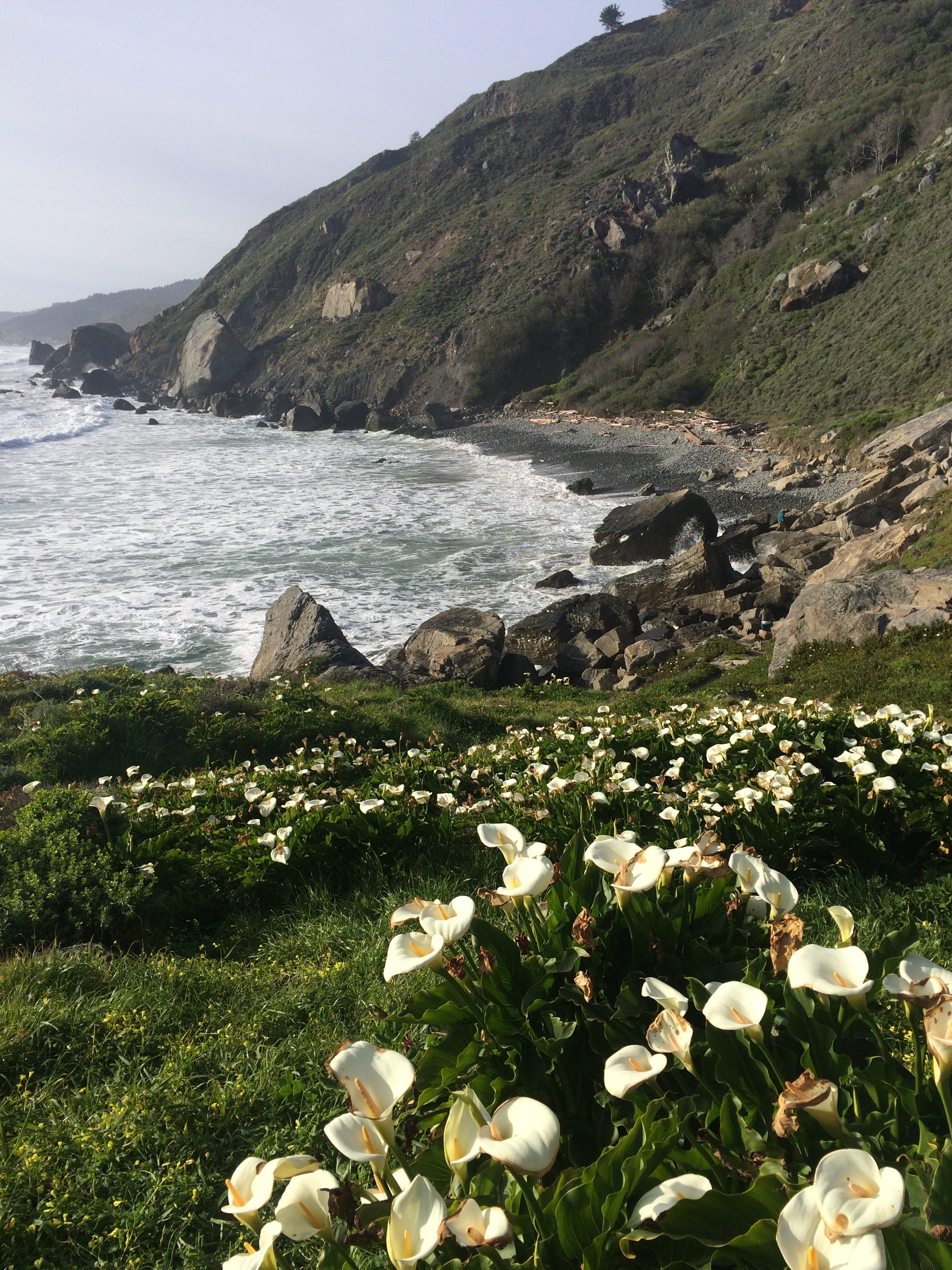
But I can say that the sea has a magnetic pull for me, that salt water air. Something about it heals, just by proximity.
When I fall into a hole I go to the ocean.
I drive north on Highway 1, and hope it falls away. The road dips inland to Tomales at the mouth of the creek, and I hold my breath until I get back out to the water in Bodega Bay. It is only thirty minutes of inland road from bay to sea but it feels like reaching the edge of the continent after the longest overland trek.
I look at the rocks on the sand in each of the coves at the river mouths, and nothing looks real. It is so beautiful it seems impossible. Beyond words.
We bring our surfboards and in the morning there are no waves at Point Arena so we go further north. In Manchester we shade our eyes from the tops of the dunes and watch a lone, brave surfer. We agree that neither of us are strong enough to surf these waves. A man on a pointy red board, paddle-paddle-paddles then slices the steep faces of the ten-foot waves on his knees. We watch, west, and we are filled with fear and admiration.
I stretch on the ground above the high tide line. We look out in silence. We throw driftwood in the little creek. When I get home I have sand in my pockets and I can feel the residual roar.
I do not know who I would be if I lived in a land-locked place.
•
What do you say in the spring time, when you’re emerging from the heavy, wet part of the year? From your lowest low?
I always have to remind myself that spring is half dark. I like this part of spring, the part that is still slow, still cold. It is an emergent time, into the light, the time when I feel change most potently. I don’t always know how to speak in this time. It is a transition. It is awkward.
Spring reminds me that I will die. This sounds morbid, unless you grew up Catholic, which I did. Every year I eagerly awaited Good Friday because it meant school would end early, after we walked the stations of the cross. Our grandma would pick us up and take us to the kids buffet at Sizzler in Serramonte. There was no homework on Good Friday, and we ate fish for dinner, and then it was spring break and we had five whole days to watch MTV.
Two days after reenacting a brutal march to crucifixion we’d eat ham and candy to celebrate the impossible: a dead man, resurrected. Bunnies have babies. Chicks made of sugar symbolize hope and renewal. But I always had trouble with how illogical it all seemed. Why did he get to escape death? Wasn’t ascending to heaven the same as dying? So, did he die twice? Did he float up? On a light beam? Why did we have to say Jesus is risen instead of Jesus rose, or Jesus has risen? Why did correct grammar not apply to this guy?
I did not feel convinced. I felt bad for the guy—what a merciless march—but I felt worse for myself, because I knew I would die someday and I knew I would not crawl out of a tomb two days later. I would not rise. I would turn back into dust, like the ash that had been thumbed onto our foreheads a few weeks earlier, and that would be that.
•
My mom died three years ago in late January. I remember feeling grateful that she did not die on Christmas.
I remember, in the week after she left, we raked the rotting leaves in the yard to prepare for the influx of family coming for the cold winter memorial picnic.
Under the brown leaves that were not my dad’s priority that winter, there was growth. Small green blades. I remember thinking mom had good timing. She did that for us. She timed her death with the dawn of spring.
The hopeful purples and whites and neon greens of the soft new life beneath the brown crunch—it felt as if that was a trade we had been coerced into making.
We trade you, impossible mystery of existence: one bright-eyed mother, too soon, in exchange for spring coming again. We trade you, great empty, one ephemeral being, in exchange for your promise that these cycles will never stop.
•
I am not a person who can feel wordlessly. I need language. Last month, nursing a freshly re-opened grief wound, I watched the waves pummel the shore at Baker Beach, hoping the chaos of the churning whitewater might make me feel something. I can sense the dull ache through the sheen of the numbness; it’s there. These waves might pull it out if I let them. I want to cry so badly.
I cycle through metaphors in my head, looking for the right one. Is my sadness being thrashed in the surf? Or is my sadness the churn, and am I that bird? When the wave approaches the shore, is that...life? Cycles, and phases. Incessant. Am I the sand, pounded by grief, eroded bit by bit until I am a steep beach? Is grief a rip current? Is cancer a sneaker wave? What about the face of the wave, the dark part?
I go now to surfing metaphors. The darkest part of the wave, the part you’re supposed to paddle towards even if you’re scared—is that death? Or is that life, because life is dark too? What I want to know is: which part of the wave will save me?
In moments of hesitation, when I need inertia on land, I conjure the sound of my friends shouting at me, fresh baby surfer: “go-go-go, paddle-paddle-paddle.”
In moments on the precipice of extreme lows, when I’m feeling resistant to letting the dark in, I hear my cousin at my mom’s funeral, telling me to ride the wave, man. When it’s coming for you, you can’t go around it, you have to go with it.2 If you can’t go with it, you have to go through it, ducking into it headfirst. You pop out the other side.
When I am watching waves, I feel over and over again the cycle of tense anticipation—waiting, waiting, waiting... and exhale. The uncomfortable expectancy that hurts so bad and pushes you to the edge, further than the edge then... relief. Inevitably. Always. It always crashes. And if you play your cards right you can ride it to the shore.
•
Grief is a place you can’t know until you get there. Joan Didion said this, or something like it. It can be described in perfect detail, but until you’re in it you can’t possibly understand its power.
I wonder if the ocean is the same, but someone else will have to tell me, because I don’t remember the first time I saw it, got in it, got under it.
You can’t just read about the important things. I think similarly you can’t really speak about them. Language evades. You can’t understand something vast and mysterious from hearsay, from anecdote. It is the doing of the thing that is crucial, the being in the place, the feeling in your fingertips. I’ve watched the ocean from the shore. I’ve been in it, alive with fear and awe. I’ve watched death from an intimate yet still safe distance. Someday I’ll get all the way in and it will be beautiful and terrifying.
•
There are different ways of holding space for someone’s presence, Daniel tells me this as we sit on the bench outside our studio at the Headlands, looking towards Rodeo Beach and the great Pacific beyond.
There is the physical way, the way that you can hug someone in front of you or make them coffee or speak to them in words that they will hear with their terrestrial ears.
And then there are other ways, ways to hold presence like it’s an impression. This is the only way that we have left when a body is gone. This is the way that we try to name but can’t always, because we can’t see it with our eyes. We use words like spirit, and legacy. Impact, feeling, linger, influence. Words like ghost.
Daniel tells me that he does not think one way is better than the other. They are just different ways. Sometimes we have both options, and sometimes we have only one.
•
Try these.
Standing at the edge of the earth is like
Standing at the edge of your life is like
Standing at the edge of the earth, looking into the great empty, is like
Standing at the edge of all that is known.
Yelling to be heard over the roar is like the feeling of asking to be seen.
Standing at the edge of the earth, on a sandy eroding cliff that might drop out beneath you, is like
Standing in the sand and being eye-level with six foot waves and understanding your smallness is like
Paddling as hard as you can to get back through the whitewater and into the peaceful rocking of the waves before they break but being repeatedly thrashed because you have no upper body strength is like
Looking as far as you can see but still seeing nothing but nothing is like
•
My aunt has cancer. She calls me a few Saturdays ago as I am chopping wood, splintering the big chunks of Doug Fir into kindling.
This tree was 150 years old when we cut it down. I think about this as I swing the hatchet to the edge to shave off little pieces. This tree grew for a century and a half and we will burn it in two winters. I reconsider the romance of woodfire heat.
She calls, and asks me if I’m sitting down. Well, no, and is that a real thing? Do people collapse when they hear bad news? Who died, I say. I have breast cancer, she tells me. I can’t imagine worse news.
She feels bad telling me. She felt bad telling my dad. She called me because he couldn’t. Dad doesn’t know how to deliver bad news, my mom always did that part.
I have breast cancer, she says. Like your mom. Like my mom, and her mom. We talk about lumpectomies, and hormones and menopause, about gene tests and radiation, and her daughters.
My aunt was 17 when her mom got sick. My cousin is 17. My little sister was 17. I was 19, like my dad. My smallest cousin is 14.
My aunt tells me to call my mom’s doctor to get her records before they throw them out, because when I get breast cancer they’re going to want to know what kind she had, when it arrived, what the markers were. She doesn’t say those words, when you get breast cancer, but that is obviously what we are both thinking.
I call the Willamette Valley Cancer Center. They tell me my dad must call, the husband is the default power of attorney, not the child. This frustrates me.
I wonder if I should tell them that I am my mother’s proxy, and I always have been. I’m the one who cooks Christmas dinner now, the one who reminds my dad to buy birthday presents for his grandkids. I’m the one who ordered the death certificates, who cancelled Sunset Magazine, who called the crematorium to ask when we should come pick up the cardboard box.
I’m the one who looks like my mother.
I’m the one who finished piecing out her last quilt, with Mom pointing from the hospital bed in the living room as I pinned the squares to the curtain.
I wonder if I should explain to the lady on the phone that my aunt, the one with the breast cancer, is the other boss in this situation. She is the one who flew back to Oregon weeks after the funeral, to sift through stacks of paper, to help my dad plan the rest of his life. She was the one who knew how to take my mom off the title of the Subaru, how to deal with her life insurance and 401k.
I decide not to explain and instead I ask them to please mail my dad the release form, because he is bad at email and doesn’t know how to use the printer that I bought him even though I taught him how to use it.
I wonder where we are going to keep these records. In a box in the barn? On a shelf in the guest room next to mom’s garden books? Will they come in a binder? As a PDF? I hate this.
We become adults gradually, constantly. Thousands of small moments, pinpricks, not one big punch in the gut like I thought was coming when I was a teenager.
I became an adult on my 18th birthday when I could show my real ID at the gas station to buy cigarettes. I became an adult again at 19, in my bedroom in Portland, on the phone with my mom as she told me she was sick. Again at 26, when I aged out of my dad’s health insurance. Again at 27, when mom told us that she was sick again.
You become a certain kind of adult when you hold your mother’s hand, notice that it looks exactly like your hand, and admit to yourself that she will never meet any of the children that you don’t even know if you’re going to have because you haven’t thought about that yet.
You become a certain kind of adult when you give your mother’s eulogy.
My mom was electric. She vibrated with positivity, she emanated warmth. She would make you feel alive just by being around her. You’d leave her presence with a rosy glow. I miss that feeling.
•
Death is a marker of time.
But when I place death near the ocean, when I place time on the ocean, it tips my brain just outside of the range of comprehension. When I stand on the shore and think about human time scale, our life cycles, in relationship to the ocean’s cycles, it’s almost funny.
The chasm is infinite. We have a start and a stop. The waves do not.
There is so much power out there,
Far out.
•
Time is movement.
Waves move forever.
Time is cycles. Spring, or sadness.
Tides are time, and so is fog.
On the California coast, fog is a season.
So is wool socks.
Time and tides are rotation
and centripetal force;
the ceanothus bloom is a season.
Fog is memory.
Sand in my pockets is health.
The crest of each wave
is at once the start and the end
of the rest of my life.
Death is certain.
Sun is weather.
Light is time.
And tides are each a season.
I realize that this stance on voting is a contentious position. I am in California which is not a swing state. I have the privilege of using my vote to reflect my values and to send a message: no more two-party system. If you live in a swing state you have a much tougher choice to make about how to strategically use your vote.
Any other toddler parents hear this in their sleep? “We can’t go over it, we can’t go under it, oh no! We have to go through it! Splish splosh splish splosh splish splosh…” It rings so true.
Love love love this.
This felt so special to read -- thank you. xx